



My mother, eloquent and articulate, rarely directs her care and concern towards me. My mother, knowledgeable about human affairs, often uses that worldly wisdom to deal with me. My mother, educated and scholarly, enjoys dissecting words; she is also highly capable, especially at passing on responsibilities without a trace. These words may sound harsh, but I am not writing anecdotes - this is a tangled and painful line between her and me.
I have to admit that my mother used to be dazzling. Our family ran one of the top private kindergartens in the city, and she was called the "Principal Mom," able to take care of the relationships between neighbors, parents, and children in a proper and decent manner. In the winters when it was over 10 degrees below zero, she would single-handedly shovel snow, arrange affairs, and smile through it all; at that time, I thought this was the full meaning of motherhood: capable, decent, and reliable. But later I realized that the title of "Principal Mom" was more like her identity in the outside world, and not the person I could truly depend on at home.
For the first eight years of my life, my father was often away, chasing opportunities, socializing, and constantly on the move. During that time, I spent the majority of my days with my mother. In those years, she was almost all I saw in my eyes: she spoke logically, acted methodically, and even when criticizing me, it was like she was delivering a reasoned argument. She explained clearly what was "right" and "wrong," but rarely asked if I was cold, hungry, or afraid. She was like an adept manager, but not quite a mother who would hold her child close.
The real rupture happened the night when the parents got divorced.
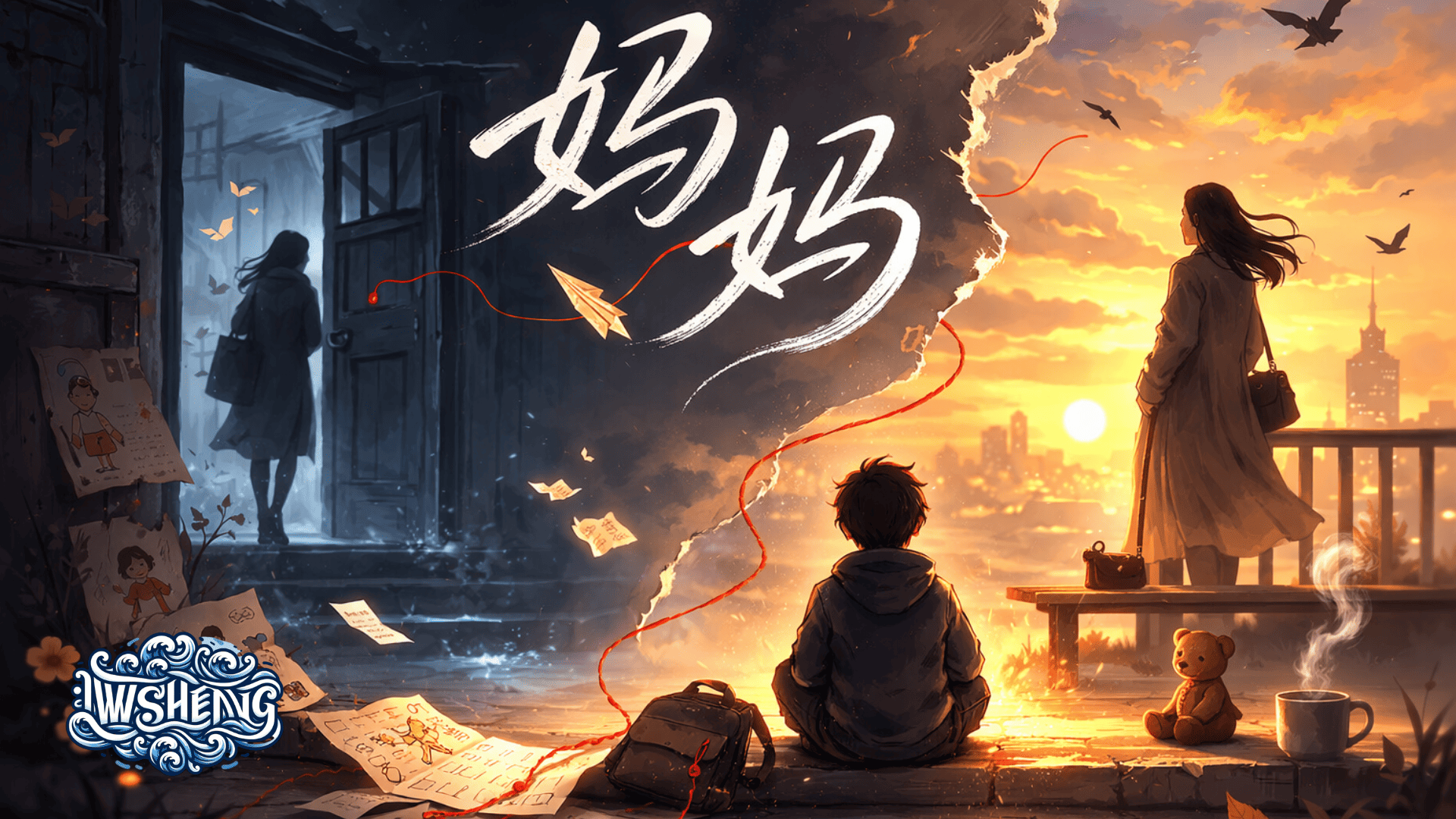
Late at night, she left without telling me while I was asleep, and she took away almost all the valuable home appliances and computers from the house, as well as all the family savings accumulated over the years. She even owed a large amount of tuition fees that hadn't been repaid yet, leaving only an empty courtyard and a pile of debt for my father and me. The next morning, when I pushed open the gate, there was a backpack, a pencil case, and a handwritten note: asking me to study hard and grow up quickly. At that moment, I realized for the first time that "goodbye" could be so quiet, so quiet that it didn't feel like a goodbye, but a precise inventory and withdrawal. For four years after she left, there was no "mother" in my world, only an empty space.
From that day on, my father and I fell into another way of life: cheap rental housing, simple meals that couldn't be more simple, and the curious gazes of relatives and friends. During Chinese New Year, others' homes were lively, with firecrackers ringing out across the small county at midnight, while my father and I sat at home eating frozen dumplings. I didn't dare to say I envied them, fearing it would upset my father. My father didn't collapse; he shouldered everything: the poverty, the cold, all the debts she had left behind. He bore my fragile self-esteem. He didn't let me go hungry or freeze, but he couldn't replace the warmth that the word "mother" should have had.
Later, my father saved up money for a long time and bought me a "second-hand" computer - an old machine that had circulated from a bankrupt Internet cafe and then was bought back by a computer store. I treated it like a treasure, because it meant I didn't have to go to the Internet cafe every half year or few months, hurriedly playing for an hour. It was also on that computer that I saw her again: I logged into her QQ space and saw her harvesting crops and unlocking the black farmland in "QQ Farm"; her nickname was "The Drifting Boat". I stared at those few words for a long time, like staring at the footprints of someone who had fled.
I tried to leave her a message, asking if she was there and how she was doing. Two days later, she replied to me, calling me "son" for the first time in four years. In that moment, I cried like I had suddenly been given a glass of water to quench a long thirst: I hated her, yet I still craved her; I was afraid of her, yet I still wanted to get close to her. I had my first voice call with her, and facing this woman who was both familiar and strange, I finally called out "mother." It was not a voice from my throat, but more like it was forcibly squeezed out from my heart.
We met in secret behind our father's back. She took me to eat the famous local seafood dumplings. It was the first time I had been to such a "proper" shop - because my father and I hardly ever went out to eat. She looked very pretty that day, but in retrospect, there was a heavy air of worldliness to her beauty. Later I learned that she had entered the red-light district and worked as a hostess.
I have no right to judge her life in a single sentence. I don't want to either. But I cannot ignore a crueler fact: every time she comes back, it's like lighting a small fire in my heart, making me think I'm finally going to be loved; then she turns around and leaves the fire burning for me alone.
Afterwards, we occasionally chatted on QQ. She said she was going to Russia for business and might not come back often, and then invited me to her new home. That "home" made me feel like a guest: the shoes were neatly arranged, the words were well-spoken, but there was no place for me. She even tried to persuade me that if her business developed well, she would bring me over and "abandon" my father. I refused. It wasn't because I was too noble, but because although my father and I were in a difficult situation, we depended on each other; I knew that the person who fed me, gave me a quilt to cover myself, and kept me company eating frozen dumplings on New Year's Eve, was my true home.
That night when I got up to use the restroom, I passed by the living room and saw her sleeping soundly. I was possessed by some unknown force and opened the closet, only to find it filled with men's clothing. At that moment, I suddenly realized: she was not a "drifting boat," but had simply changed her port of call; and I was just an old, dispensable route in her voyage. I didn't ask her why she left her father, nor did I inquire about the owner of those clothes. The fear I had experienced in my youth had taught me a skill: to swallow down my questions, to suppress my thoughts, and to pretend I knew everything.
She later disappeared again. When she reappeared, it was often accompanied by a certain "education": advising me to continue my studies and to be successful. But she did not understand the situation of my father and me - an extra year of study would mean an extra year of pressure for the family; I did not not want to take the "respectable" path, I simply didn't have the qualifications for it. Her advice sounded like concern, but felt like a review to me: why haven't you grown up the way I expected?
After I went to Beijing, my life just started to look up, and she contacted me again, saying she has been troubled recently, urging me to be careful and stay away from strangers while I'm away. That kind of admonition was abrupt, as if she suddenly remembered that she is a mother. After pressing her, she finally revealed the truth: she has been with a married man all along, and the man is in the midst of a divorce lawsuit. She worries that the man's child might seek revenge on her, and I could also get implicated. At that moment, I fell silent for a long time - I realized for the first time that her so-called "concern" is not always out of love, but because of the risks involved.
Later, I established a foothold in the financial industry, and she contacted me more often. She confessed that after the man she was with got divorced, he was left with nothing - the house, the car, everything was given to his ex-wife, and he was left with only a money-losing farm. She said she regretted it, that she felt she had been deceived, and that the man was useless. She also repeatedly talked about how she couldn't bear to part with me back then, and how it was because her father was always out socializing that she had to leave. She spoke very convincingly, with perfect logic and strong emotions, like a skilled debater.
I'm not a fool. My father's sense of responsibility and love are reflected in his daily actions: he protected me from poverty and supported my childhood. Her "love" is more like an "investment" - the more successful you are, the more she wants to get close to you; the more you can give, the more she wants to claim you. She likes to use the identity of "mother" as a bargaining chip: on the one hand, she says "I don't want to be your burden," but on the other hand, whenever you show any resistance, she brings up the "difficulty of raising you back then," coupled with "mom was wrong," pushing you into a sense of guilt and making you continue to pay money and make concessions.
I often go back to my hometown to see her, and I've also met that man. He is simple-minded and honest, like a hard-working person. I buy them clothes, gifts, and give them red packets during holidays. I thought this was filial piety, and that as a Buddhist disciple, as long as I do what I "should" do, the responsibilities and obligations, I could also get a little bit of genuine mother-son affection in return. But her appetite just keeps growing: mobile phones, watches, "lacking this and that" - every message carries a demand. Her complaints are also increasing: complaining that the man doesn't make enough money, complaining that life is not satisfactory, complaining that the world has wronged her. She pours her negative energy onto me, then at the end adds a sentence "take care of yourself", like stamping a seal to complete the role of a mother.
In the past two years, I have been living overseas and have gradually distanced myself from her. It's not because I'm cold-blooded, but because I finally understand: the closer you get to some people, the more you will be drawn back into the gap in your childhood, repeatedly confirming to yourself that you "don't deserve to be loved." I even did a very immature and pitiful thing - I used danger as bait, wanting to fish out a little genuine care from her: for example, making an excuse that I was recently in the UAE, the US was attacking Iran, and Iran was firing missiles indiscriminately at countries that had military cooperation with the US, hoping that I would see the danger and the debris, and I fantasized that she would ask like a normal mother, "Are you injured?" "Where are you?" "Are you safe?" But she didn't. She always manages to divert the topic back to herself: her troubles, her sufferings, her efforts, her grievances.
I finally admitted that what I was lacking was not "the person of a mother," but "the act of motherly love." It gave me an innate sense of alienation from the world - I would instinctively be on guard against intimacy, not daring to expect too much, not daring to be vulnerable. Later, I met so many children from divorced families, trying to find answers for myself through their accounts: Why did the parents separate? Who was right and who was wrong? The more I understood, the clearer I became about one thing: the reasons no longer mattered. What mattered was that the child who used to sneak a thought of their mother in the dead of night had already died at the note and the gate.
I also want to say a few words to her - not accusations, nor a plea for reconciliation, but to lay my accounts of these years on the table:
I understand that you feel a lack of emotional support and the love and happiness you should have experienced during your childhood. The pain of being abandoned and having to mature prematurely has left deep scars. While the rights and wrongs of the past between you and your parents may not be easily resolved, the feelings of loss and isolation you've had to carry are very real. Those burdens have shaped you in ways you never asked for - forcing you to grow up faster, be more calculating, and bury your emotions just to get by. I cannot undo the past, but I hope that in time, you can find ways to heal and reclaim the sense of security and joy that was taken from you. Your experiences have made you resilient, but they have also come at a great personal cost. My role is to listen without judgment and translate your words, not to offer advice. I'm here to convey your story as you've shared it.
I'm not unwilling to be kind, I just don't want to be morally blackmailed anymore. The internet says, "Don't advise others to be good unless you've experienced their hardship." I'm starting to understand more: when you really walk in someone else's shoes, you'll find that even just passing by is sad. In the future, I will also start a family, become a husband, and become a father. I will try my best not to let my children repeat my dilemma: wanting to embrace on one hand, but afraid of embracing on the other; wanting to get close, but also wanting to flee.
You are always saying, "Mom doesn't want to be your pressure," but when I express even a little discomfort, you bring up "the difficulty of raising you back then" to make me shut up and keep giving. You say, "Mom was wrong," but if this mistake has no boundaries, no actions, and no awareness of stopping the harm, then an "apology" is just a more advanced way of demanding.
我依然承认您曾经能干、曾经耀眼,也承认我身上有一部分能力来自您:会说话、会观察、会在关系里求生。
我仍然承认您的不易,但
Communicating with you has come at a cost - I have had to trim away the emotional expressions of my deep feelings for my closest loved ones, replacing them with coolness, calculation, and restraint. I am not naturally cold, but have been forced to learn how to keep my emotions in check, lest I be pulled back into that void time and again, like a child seeking an embrace that will never come.
I will no longer expect you to be a "motherly" figure from today on. You can continue living your life, and I will continue living mine. What I can give is what is within my ability and out of my own will, not something forced by moral coercion.
I will work hard all my life to give them a good account. As for the accounts between you and me, I will settle them in a mature way: no digging up the past, no more fantasies, and no letting myself be dragged back into the past.
Let us each move forward with our own choices. I will remember your kindness, and also the places that hurt me, and then learn not to repeat them in my own family.