

That night I remember very clearly.
On New Year's Eve 2009, it was the coldest night I can remember. It was over a dozen degrees below zero, and the breath we exhaled turned into mist. The rented houses in the slum alley had never had heating, and the peeling walls were so damp that they seemed about to fall off. But every household had hung lanterns, and the colorful lights illuminated the narrow alley in red and green. The sound of firecrackers kept coming in through the cracks in the windows. Outside, it was the New Year, but in our house, something was missing - I thought about it for a long time before I could articulate it: It wasn't the money or the food that was lacking, but the lively, festive atmosphere.
That year, my mother had already passed away.
When she left, she took advantage of the late night to take away the valuable electronics and savings accumulated over the years from the house. She even didn't leave the preschool tuition fees that the parents hadn't withdrawn yet, and only left a backpack and a note at the door: "Study hard and grow up quickly." That farewell was so clean, it didn't seem like a farewell, but more like a premeditated check and withdrawal. After the courtyard gate was closed, the "mother" in my world disappeared, leaving only an indescribable void - I was too young at the time to know how to hate, I only vaguely felt that something was missing, and it kept on being empty.
After that, my father and I fell into another kind of life. Cheap rental housing, the simplest meals, and the curious gaze of relatives and friends.
On New Year's Eve, my father went out during the day and came back in the afternoon, bringing a roasted chicken from my uncle's family. They were the best neighbors when we were running a kindergarten, and one of the few true brothers left at the time. We had a simple dinner, finishing the roasted chicken with a few bags of pickled mustard greens. That was my favorite pickled mustard greens, and still is, maybe not because it tastes that good, but because it's only 50 cents a bag and available at the small store near our house, cheap and goes well with the meal. If not for the Spring Festival ads on TV and the occasional firecrackers from outside, I almost forgot that day was New Year's Eve.
That night, the CCTV Spring Festival Gala was being broadcast as usual. My father and I were cuddled up in the quilt, with the outside cold and the room also cold, and the breath we exhaled looked like white smoke, only the quilt was warm. The skits were the same old ones, and the rest of the programs were not very engaging, but we still didn't change the channel, just leaning against each other. The camera showed a scene of guests on site sending dumplings, steaming hot, and I stared at it for a while, not knowing whether it was because I was too hungry or just didn't understand at my young age, and I blurted out: "I want to eat dumplings."
Father was silent for a moment, then sighed and turned to look at me, his tone serious: "You're right, we should eat dumplings for the New Year. You wait here, I'll go buy some."
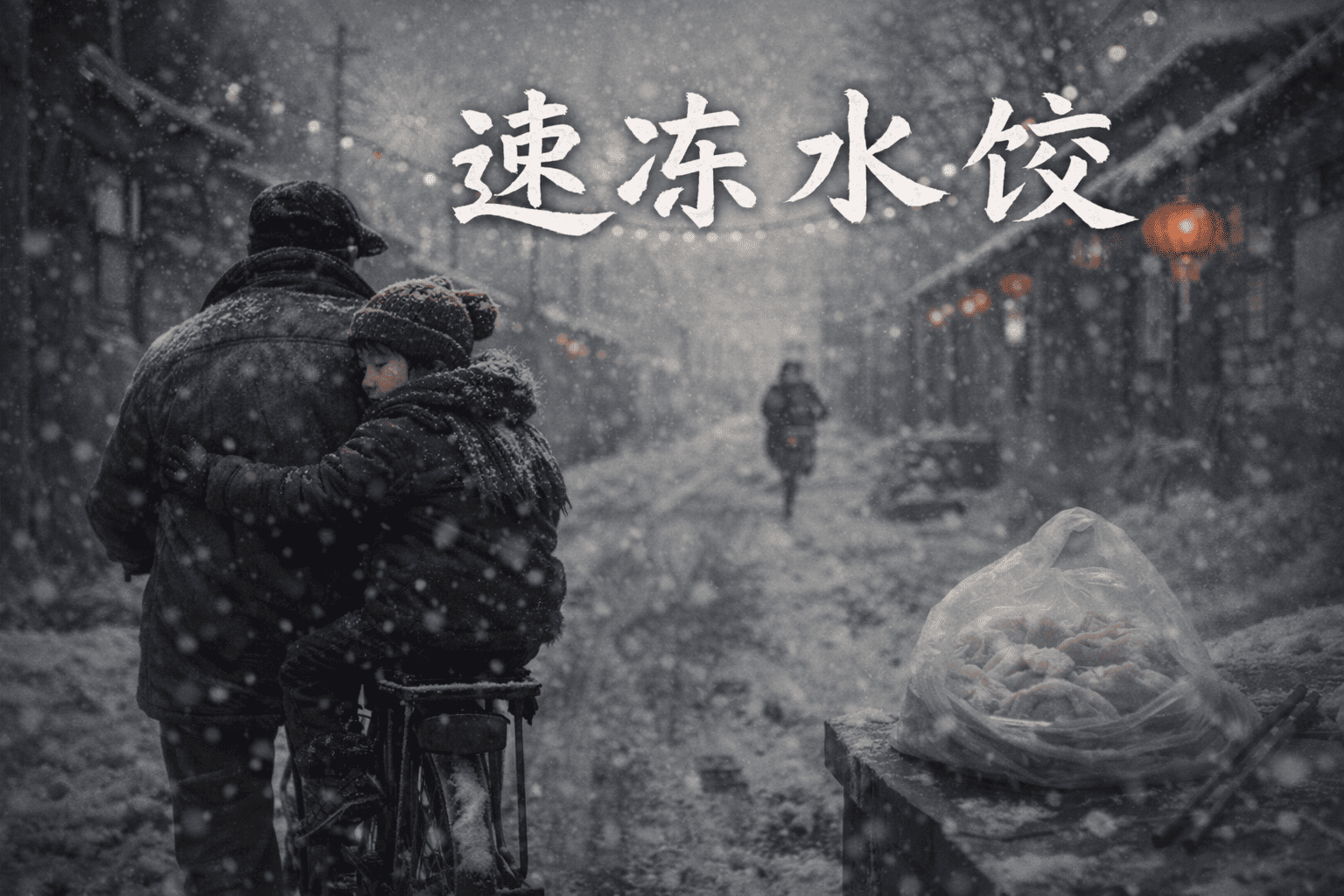
I stuck to him since I was little, of course I had to follow him. My father didn't stop me, and let me sit on the back seat of the bicycle. It had just snowed in the evening, and the road was covered in thick snow. The wheels made a creaking sound as we rode, and we carefully rode through several blocks before finding a supermarket that was still lit up. My father pushed open the door and looked around the freezers outside, but didn't stop. He walked a few steps inside and finally chose some loose frozen dumplings - three dollars a pound, but he only bought one pound. Later I realized that he didn't buy the bagged ones because they were more expensive; he only bought one pound because there was an electricity bill to pay the next day.
That night, sitting on the back of the bicycle with my arms around my father's waist, I didn't feel the cold at all. We chatted and laughed, the wind blew by, and I pressed my face against his back. The road was long, and there were hardly any people on the street, just the two of us, our shadows stretched long by the streetlights.
I don't understand that at the time, but later I realized that's what they call "happy with what you have" or "being content with less".
Upon returning home, I boiled the dumplings in a small electric pot. The pot lid gently bounced from the steam, and a white mist filled the room, bringing a touch of the New Year atmosphere. Father only ate two or three dumplings, and pushed the rest towards me, saying, "Dad's not hungry, you're still growing, so eat more to get taller." I believed him then, but later I understood that it was because he couldn't bear to eat them all.
The bowl of loose-pack frozen dumplings added a warm touch to that New Year's Eve.
I still like to eat frozen dumplings even until now.
I don't think it's because they taste particularly good. To be honest, the bulk items at the supermarket that cost three dollars a pound have thick skins and little filling, so there's nothing special about the flavor. But every time I see dumplings, I can't help but think about that little electric cooker, that rented apartment, and that New Year's Eve when a little child was curled up in the blankets, with a red nose but bright eyes.
Sometimes when I can't sleep, I think about whether there are things in a person's life that are forever frozen at a certain temperature - not fading with the passage of time, but becoming clearer as time goes on. For me, frozen dumplings are one of those things. They are not expensive, not fancy, and may even seem a bit shabby on today's dinner table; but they have held some of my most important memories, held a father's silent love for his son, so they have weight and significance to me.
That period of time has also left some other things on me, deeply hidden, silent, but occasionally they come out to remind me that they are still there.
For example, when eating, if there's only one dish on the table, I won't be the first to pick up my chopsticks. It may be the courtesy of the older generation, or a tightening of that innate string - afraid that the family has nothing to eat, afraid that my wife has nothing to eat, afraid that this one bite will be gone if I eat it. This feeling may sound a bit ridiculous, but it is real, it is the conditioned reflex that the scarcity of that era has etched into my body, and I can't change it, nor do I intend to.
For example, when going to the supermarket, seeing frozen foods, packaged snacks, or dry goods and condiments that don't expire quickly, I habitually take two portions. It's not because I'm greedy, but because there's a voice in my mind saying: What if I only buy one, but then want to eat it again later and it's gone? What if I can never find it again? What if it's sold out next time I come? What if I can't afford it next time? This voice comes from my younger self, who has witnessed "good things suddenly disappearing" and "what's available today may not be there tomorrow". So I've learned to hold onto as much as I can in the present, to leave as much behind as possible.
I know this is called a sense of scarcity, a psychological shadow left by childhood poverty. But I don't want to deliberately try to dispel it. Because it is this "reluctance to let go" that has always made me remember where I came from; it is this "hoarding with peace of mind" that has prevented me from truly inflating in any prosperous circumstances. It is my origin, and also my anchor.
Life gradually got better. I left that small alley, left that rented apartment, and walked a long, long road, met many people, and had a lot of good food. But if I happen to see it while shopping in the supermarket, I still buy a bag of frozen dumplings to put in the fridge. I may not eat them that day, sometimes I just leave them there, like placing a talisman, like quietly keeping a certain sense of ritual.
Grandfather worked hard his whole life, and father worked hard for half his life. That pot of homemade dumplings costing three dollars per pound was the first lesson they taught me - not by telling me, but by living it: no matter how difficult, they must ensure the child has something hot to eat during the New Year.
I haven't forgotten. And I won't forget.


暂无评论内容